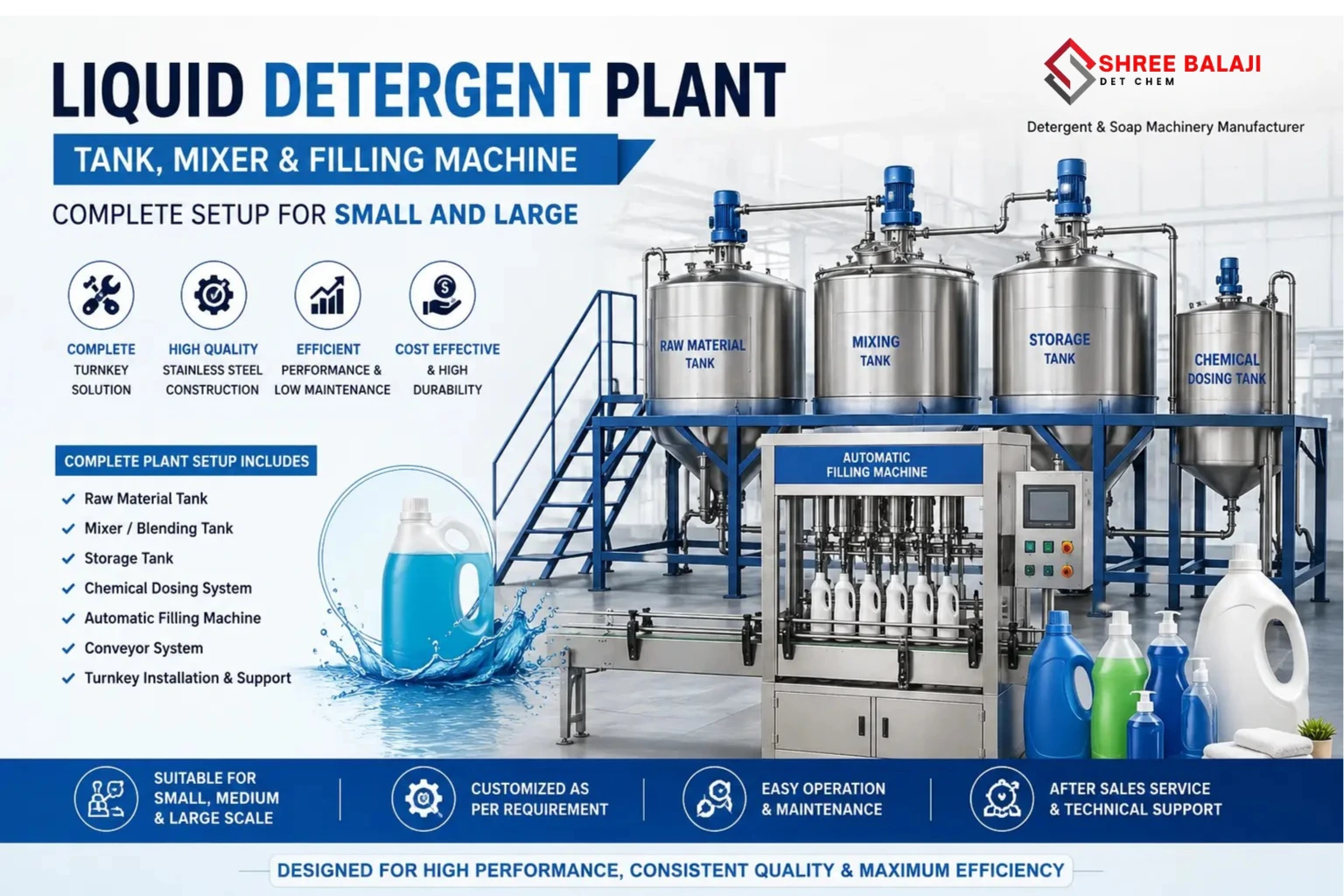
Spray Drying Detergent Powder Plant: Process, Tower Design and Buyer's Guide
Quick answer: A spray drying detergent powder plant turns a hot liquid slurry of surfactants, builders and salts into light, free-flowing powder. The slurry is pumped to the top of a tall detergent spray drying tower, atomised through nozzles, and dried by hot air into hollow granules. Heat-sensitive ingredients such as enzymes, perfume and bleach are added after the tower.
By Shivholic [Digital Brand ], [ Rameshwar steel fab ]Last updated: September 2026
In this guide: what a plant is · the spray drying method step by step · tower design · process parameters · spray drying vs other methods · raw materials · energy and eco-friendly design · safety · troubleshooting · choosing a supplier · FAQs
What Is a Spray Drying Detergent Powder Plant?

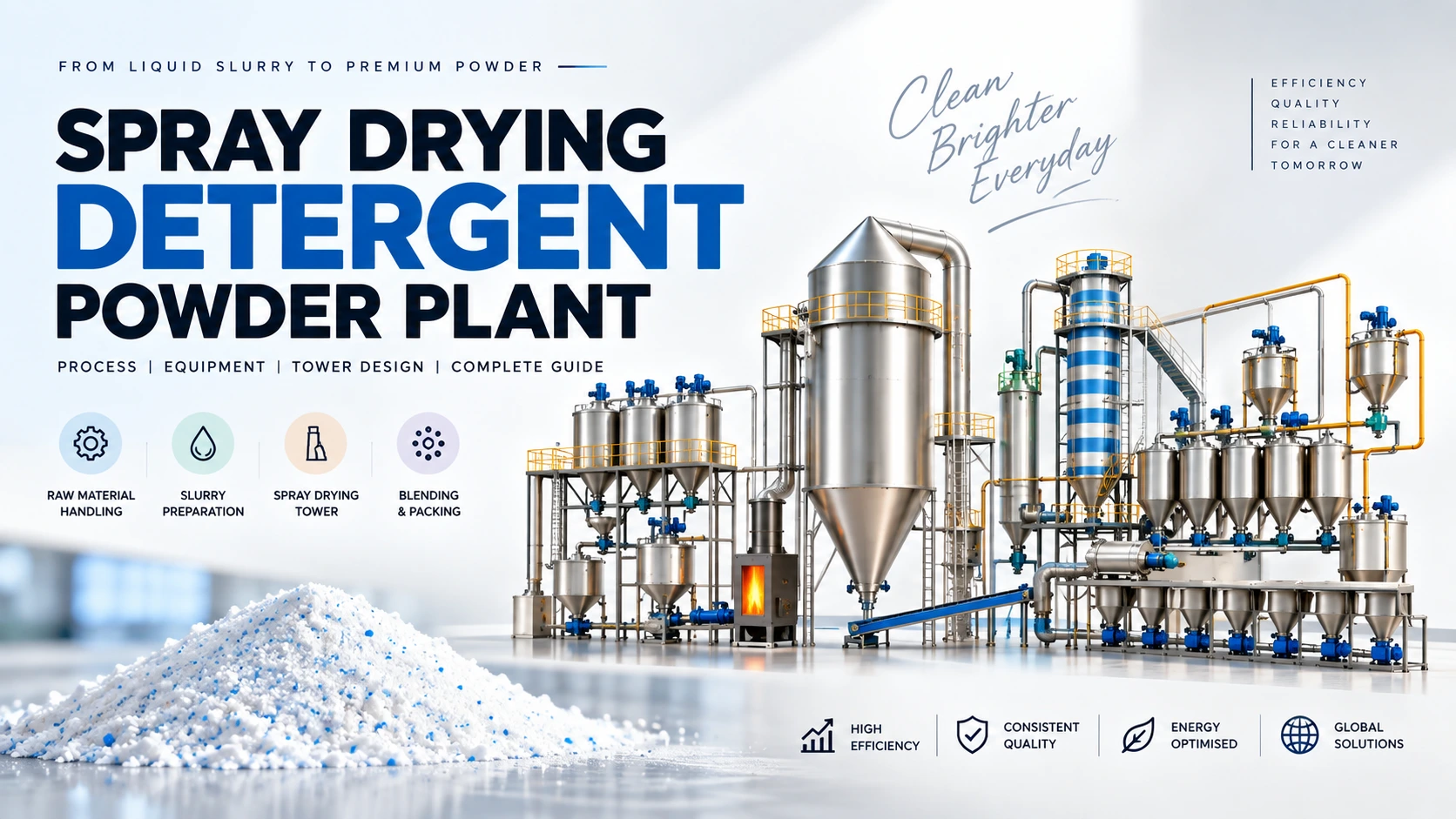
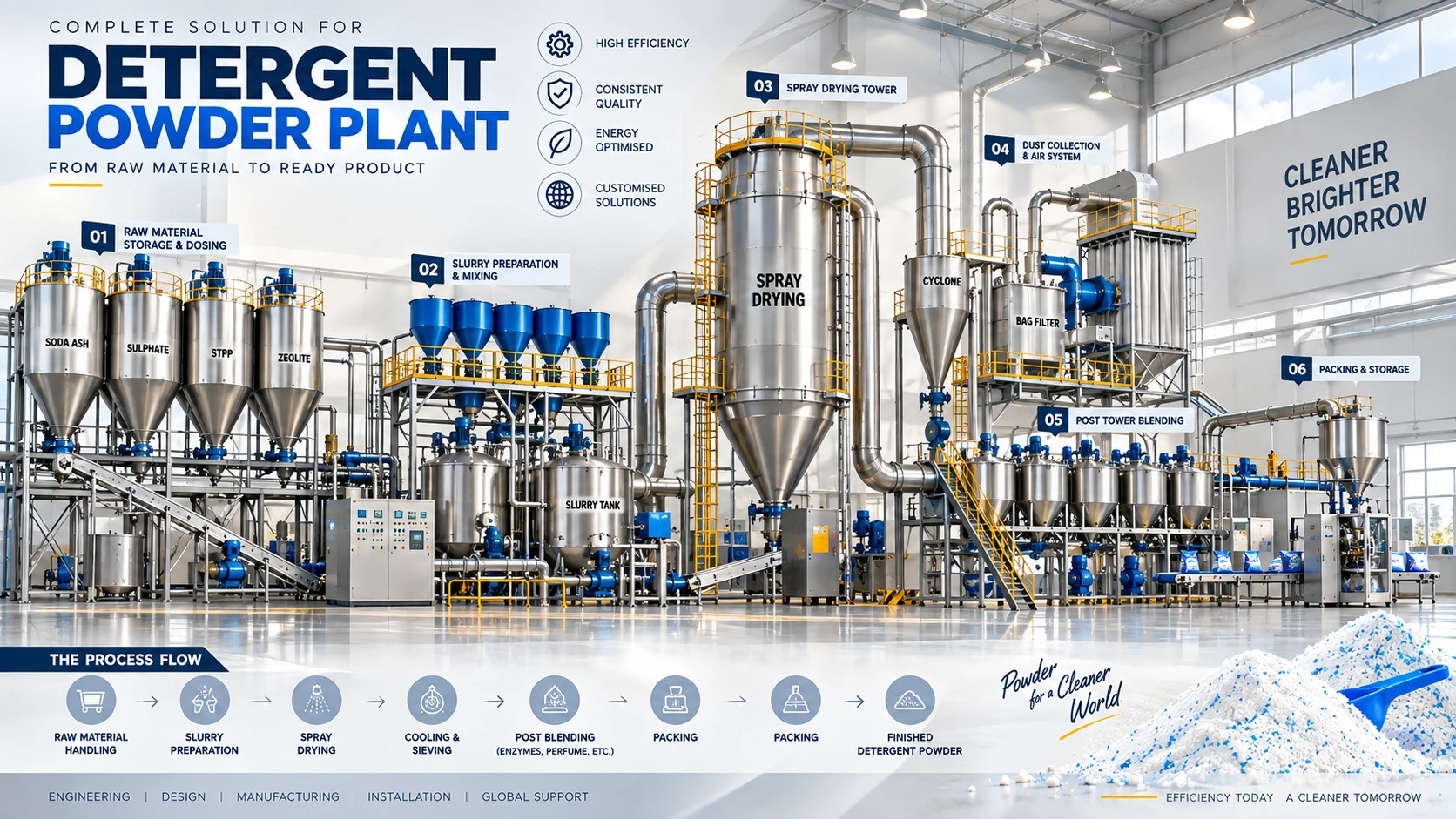
A spray drying detergent powder plant is an integrated production line that converts raw materials into finished washing powder. It covers raw material storage and dosing, slurry preparation, the spray drying tower, dust collection, post-tower blending and packing.
Most branded laundry powders in the market are lightweight, puffed powders with a bulk density of roughly 250-500 g/l. This structure dissolves quickly, flows well and resists caking. Spray drying is the most reliable way to get it, which is why it remains the standard for medium and large detergent manufacturers.
Detergent Powder Manufacturing Process: Spray Drying Method (Step by Step)
1. Raw material storage and handling
Solids such as soda ash, sodium sulphate, STPP or zeolite are stored in bags or silos and moved by conveyor, screw feeder or pneumatic transport. Liquids such as LABSA, caustic lye, sodium silicate solution and nonionic surfactants are held in tanks and moved by pumps and pipelines.
2. Automatic dosing
Each ingredient is weighed or metered to the formula. A PLC-based control system stores recipes, so you can run many formulations with repeatable accuracy. Accurate dosing directly affects powder quality and cost per tonne.
3. Slurry preparation and ageing
Ingredients are mixed in a crutcher or slurry mixer. Acid surfactant (LABSA) is neutralised with alkali, and the reaction heat helps warm the batch. A typical detergent slurry is held at about 60-80°C and contains around 30-60% water. The slurry is then aged briefly in an ageing tank so that hydration and neutralisation complete and the mix is uniform before spraying.
4. Spray drying in the tower
A high-pressure pump sends the slurry to spray nozzles near the top of the tower. It breaks into fine droplets, while hot air from the furnace or hot air generator dries them as they fall. In a counter-current tower the air enters low and rises against the falling droplets, which gives efficient heat transfer. The dried particles are hollow, porous granules. This is the semi-finished base powder.
5. Cooling, sieving and dust recovery
Base powder leaves the tower bottom and is cooled and screened. Oversize particles are removed and fines are recovered. Exhaust air passes through cyclones and, where required, a bag filter or wet scrubber before discharge. Recovered fines go back into the slurry as raw material, which reduces waste.
6. Post-tower dosing and blending
Ingredients that cannot survive tower temperatures are added afterwards in a blender: enzymes, perfume, bleach systems, colour speckles and some nonionic surfactants. This step makes the base powder a finished product with the full functional formula.
7. Storage and packing
Finished powder goes to storage bins, then to manual or automatic packing machines for pouches, cartons, buckets or woven bags.
Detergent Spray Drying Tower: How It Works and What It Includes
The detergent spray drying tower is the heart of the plant. Industrial towers are large vertical structures, commonly in the range of about 3-12 m in diameter and 20-35 m in height, with capacities from around 1 to 30 tonnes per hour depending on design.
| Tower component | Function |
|---|
| High-pressure slurry pump | Feeds slurry to nozzles at the pressure needed for correct droplet size |
| Spray nozzles and lances | Atomise slurry into droplets that control particle size and bulk density |
| Hot air generator / furnace | Supplies clean hot air; fuel can be gas, coal, oil or biomass depending on local availability |
| Tower body and air distributor | Creates stable airflow so droplets dry evenly without wall sticking |
| Cyclones and bag filter / scrubber | Capture fines and clean exhaust air |
| Powder discharge and cooling | Removes and cools base powder for sieving and conveying |
| Control system (PLC/SCADA) | Monitors temperatures, pressures and flows |
Good tower design balances three things: drying efficiency, powder quality (bulk density, particle size, moisture) and emissions. Modern designers use simulation tools such as CFD to tune airflow and heat use.
Typical Process Parameters
These are indicative values. Actual settings depend on formula, tower design and target density.
| Parameter | Typical range |
|---|
| Slurry moisture | About 30-60% |
| Slurry temperature | About 60-80°C |
| Hot air inlet temperature (counter-current) | Commonly a few hundred °C, often 275-350°C |
| Final base powder moisture | Low single digits to around 10% |
| Bulk density of finished powder | About 250-500 g/l |
| Main particle size | Roughly 0.15-1.8 mm; hollow particles up to about 2.5 mm |
Spray Drying vs Dry Mixing vs Agglomeration
| Feature | Spray drying | Dry mixing | Agglomeration |
|---|
| Powder structure | Light, hollow, porous | Dense, blended | Denser granules |
| Solubility | Excellent | Moderate | Good |
| Caking resistance | High | Lower | Medium |
| Capacity | High (1-30+ t/h) | Low to medium | Medium |
| Capital cost | Highest | Lowest | Medium |
| Best for | Large-scale branded powders | Small start-ups | Compact or high-density powders |
Spray drying costs more to set up, but it gives the best product quality and the lowest cost per tonne at scale.
Key Raw Materials
- Surfactants: LABSA (neutralised to LAS), and nonionic surfactants
- Builders and fillers: soda ash, sodium sulphate, STPP, zeolite or citrate-based builders where phosphate is restricted
- Alkalis and processing aids: caustic lye, sodium silicate
- Functional additives: CMC (anti-redeposition), optical brightener
- Post-added ingredients: enzymes, perfume, colour speckles, bleach
A typical formula uses roughly 9-17 ingredients, split between the slurry (heat-stable) and post-dosing (heat-sensitive).
Energy Efficiency and Eco-Friendly Design
Drying is the biggest energy consumer in the plant, so it is where savings matter most.
- Heat recovery from exhaust air can cut fuel use. One European plant maker reports savings of up to 18% with its heat recovery system.
- Fuel choice: select gas, coal, oil or biomass based on local price and emission norms.
- Dust and emission control: cyclones plus bag filters or scrubbers protect the environment and worker health.
- Fines recycling: returning collected powder to the slurry reduces raw material waste.
- Formulation: phosphate-free builders help meet regional regulations and eco-label requirements.
Safety and Compliance
- Detergent dust is combustible. Plan for grounding, explosion venting, good housekeeping and regular filter inspection.
- Guard hot surfaces, pressure lines and confined spaces.
- Follow local pollution control norms for stack emissions and effluent.
- Check the applicable product standard for your market. In India, refer to the current BIS standard for household laundry detergent powders.
- Train operators on PLC control and shutdown procedures.
Common Problems and Fixes
| Problem | Likely cause | Fix |
|---|
| Bulk density too high | Slurry too dense or low moisture, wrong nozzle pressure | Adjust moisture, pressure and nozzle size |
| Powder sticking to tower wall | Uneven airflow or slurry too wet | Improve air distribution, correct slurry solids |
| Caking in storage | Excess moisture, poor cooling | Lower final moisture, cool before storage |
| Nozzle blockage | Coarse particles or unstable slurry | Filter slurry and control mixing |
| High fines in exhaust | Fine droplets or high air velocity | Tune atomisation and cyclone efficiency |
| Off-colour powder | Localised overheating | Check furnace control and air temperature |
How to Choose a Spray Drying Detergent Powder Plant Supplier
Ask every supplier these questions:
- Do they offer a turnkey solution from feasibility study to commissioning and training?
- Can they show operating references with capacity, formula type and years in service?
- What is the energy consumption per tonne and what heat recovery options exist?
- Which fuel options and emission control systems are included?
- Is the plant PLC-automated with recipe storage?
- What after-sales support and spare parts availability do they provide locally?
- Can they supply phased options, such as a post-tower line only, or a packing line only?
What drives investment: plant capacity, tower size, level of automation, fuel system, emission control equipment, civil work and packing line. Get a detailed quotation with a clear scope of supply instead of comparing only headline prices.
Frequently Asked Questions
What is a spray drying detergent powder plant?
It is a production line that dries a detergent slurry in a tall tower with hot air to make light, free-flowing washing powder, then adds heat-sensitive ingredients and packs the final product.
How does a detergent spray drying tower work?
Slurry is pumped to nozzles at the top and atomised into droplets. Hot air dries the droplets as they fall, forming hollow base powder collected at the bottom.
Why is spray drying better than dry mixing?
It produces lighter, more soluble powder that resists caking and supports much higher capacity. Dry mixing is cheaper to start but gives denser powder and lower output.
What ingredients are added after spray drying?
Enzymes, perfumes, bleach, colour speckles and some nonionic surfactants, because heat would degrade them.
What capacity do detergent spray drying towers have?
Industrial towers range from about 1 tonne per hour to around 30 tonnes per hour, depending on size and design.
What fuel can a detergent spray drying plant use?
Depending on the furnace design: natural gas, coal, heavy oil or biomass.
Can I start with only a post-tower line?
Yes. Some manufacturers buy base powder externally and set up only post-tower dosing, blending and packing, which lowers initial investment.
Conclusion
A spray drying detergent powder plant is the proven route to high-quality, high-volume detergent powder. Success depends on the right slurry formulation, a well-designed detergent spray drying tower, efficient heat use and strict safety and emission control. Choose a supplier that provides turnkey engineering, transparent performance data and reliable after-sales support.
Planning a detergent powder plant?
[Talk to our process engineers at Shree balaji detchem for a feasibility discussion and quotation.