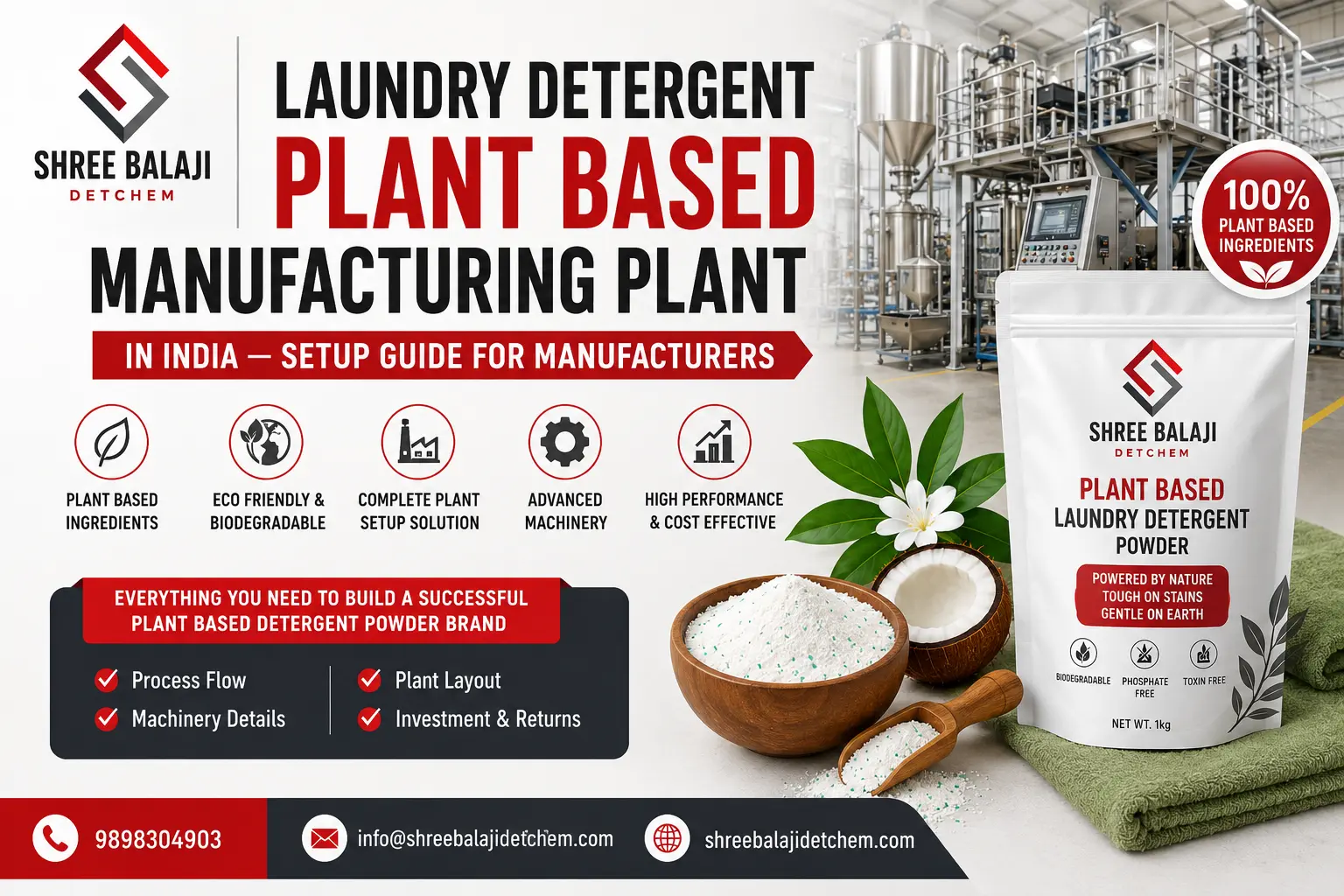
Laundry Detergent Plant Based Manufacturing Plant in India — Setup Guide for Manufacturers
What Is a Plant Based Laundry Detergent?
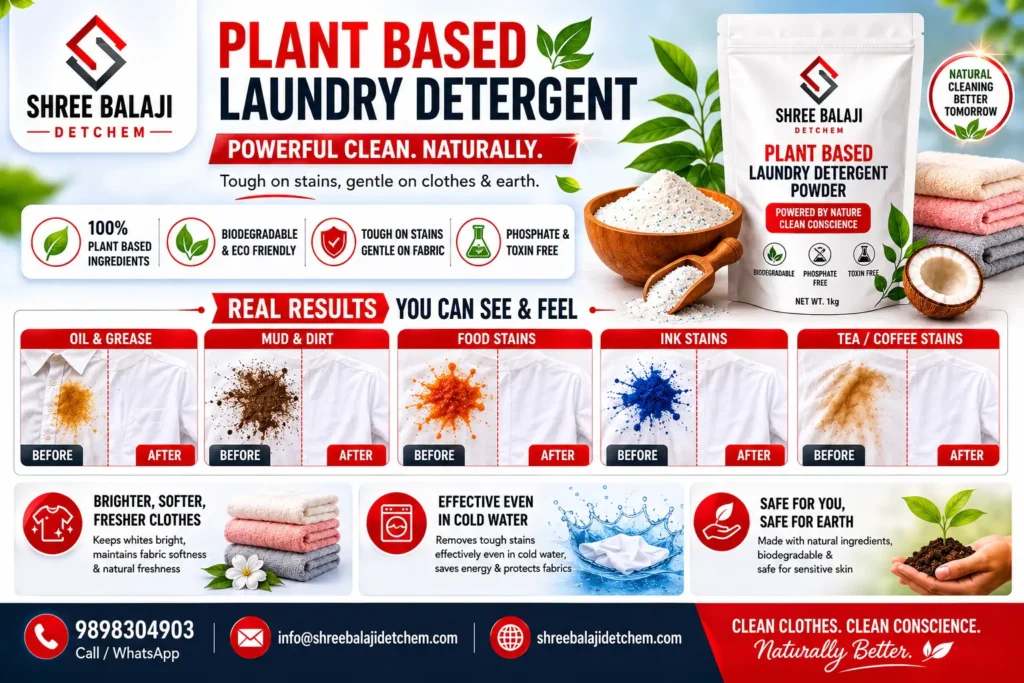
A laundry detergent plant based uses surfactants, builders, and fragrance ingredients derived from natural plant sources rather than petrochemicals. The key difference from a standard detergent powder is the raw material selection — everything else in the manufacturing process is largely the same.
The most common plant-derived ingredients used in these formulations:
Plant-based surfactants — derived from coconut oil, palm kernel oil, or sugar (e.g. alkyl polyglucosides, sodium coco sulphate, SLES from coconut)
Enzymes — protease, lipase, amylase from microbial fermentation (biodegradable)
Natural fragrance — essential oils such as lemon, eucalyptus, lavender
Anti-redeposition agents — CMC (carboxymethyl cellulose) from plant cellulose
Optical brighteners — excluded in most natural formulations
A plant based formulation drops LABSA (linear alkylbenzene sulphonic acid), SLS from petroleum, synthetic phosphates, and artificial dyes. This is not technically harder to manufacture — it is a formulation change, not a process change.
Laundry Detergent Plant Based
Manufacturing Process — Plant Based Detergent Powder
The process for manufacturing plant based laundry detergent powder follows the same basic steps as standard dry-mix detergent powder. No spray tower is needed for a dry-blend formulation.
Step 1 — Raw Material Receipt and Storage
Plant-based raw materials arrive in bulk bags or drums. Soda ash, sodium bicarbonate, and citric acid are free-flowing powders. Surfactant may arrive as a liquid (sodium coco sulphate solution) or powder. All materials are stored in a dry, covered area away from moisture.
Step 2 — Weighing and Batching
Each ingredient is weighed to the batch formula using a platform scale or load-cell based batching system. This step determines product consistency — accurate weighing at this stage avoids reformulation costs downstream.
Step 3 — Pre-mixing (Surfactant Absorption)
Liquid surfactant (if used) is absorbed onto the powder base — typically soda ash or sodium sulfate — in a ribbon blender or sigma mixer. This converts the liquid surfactant into a free-flowing powder mass that blends uniformly in the next step.
Step 4 — Main Blending
All dry ingredients are charged into the ribbon blender: soda ash, the surfactant-absorbed base, enzymes, fragrance, and any other actives. Blending time is typically 15–25 minutes depending on batch size. Fragrance and enzymes are added last to prevent heat or mechanical damage.
Step 5 — Quality Check
A sample is drawn for physical and performance testing: pH, bulk density, moisture content, and a wash test on a standard stained fabric. Plants supplying to export or premium retail also test biodegradability and surfactant levels.
Step 6 — Packing
The finished powder is discharged into the packaging line — pouch, carton, or kraft paper bag depending on the brand’s packaging format. Many natural detergent brands use plastic-free or recyclable packaging as part of their product identity, so packaging machinery choice matters here.
Machinery Required — Laundry Detergent Plant Based
You do not need a spray drying tower for a dry-blend plant based detergent powder. The machinery list is compact and the capital requirement is lower than a conventional slurry-based detergent plant.
Core Machinery
Machine
Function
Ribbon Blender
Main blending of powder ingredients
Sigma Mixer
Pre-mixing of liquid surfactant with powder base
Weighing and Batching System
Accurate ingredient measurement
Powder Conveying System
Transfer between process stages
Vibro Sifter
Screening finished powder for lumps and oversize
Bucket Elevator
Vertical transfer of powder between floors
Packing Machine
Pouch, carton, or bag filling and sealing
Optional / Scale-Up Machinery
Machine
When You Need It
Spray Dryer
Only if producing slurry-based detergent (not required for dry blend)
Screw Conveyor
Horizontal transfer of powder
Fluid Bed Dryer
If raw materials arrive with high moisture
Auto Batch Weighing
At higher production volumes for consistency
Nitrogen Blanketing System
If formulation includes enzymes sensitive to oxidation
For most new plant based detergent manufacturers starting at 500 kg/day to 2,000 kg/day, the core machinery list above is sufficient.
Plant Layout — What Space Do You Need?
A plant producing 1–5 MT per day of plant based detergent powder requires:
Production area: 2,000–4,000 sq. ft. minimum
Raw material storage: 500–1,000 sq. ft.
Finished goods storage: 500–1,000 sq. ft.
QC lab: 150–300 sq. ft.
Utility area (power, water): 200 sq. ft.
The production area needs adequate ceiling height (minimum 5–6 meters) for the bucket elevator and blender installation. Ground floor inlet, first floor blending, gravity discharge to packing is a common layout that reduces conveying equipment.
Raw Material Sourcing — Plant Based Inputs
Plant based detergent manufacturing depends on the right surfactant supply. Here are the main inputs and where they come from in India:
Sodium Coco Sulphate (SCS) — produced from coconut fatty alcohol sulphation; suppliers in Mumbai, Surat, Chennai
Alkyl Polyglucoside (APG) — imported or from specialty Indian chemical suppliers
Soda Ash (light) — Tata Chemicals, Gujarat Alkalies (India’s most competitive)
Sodium Bicarbonate — GHCL, Tata Chemicals
Citric Acid — available from standard chemical distributors
Essential Oils — Kannauj (UP) is India’s essential oil hub; also sourced from Tamil Nadu
Enzymes — Novozymes and BASF distributors in India; also domestic enzyme suppliers
Sourcing plant based surfactants is the most variable part. SCS and APG are available but price fluctuates more than LABSA. Locking in a reliable surfactant supplier before commissioning the plant avoids production gaps.
Formulation — Basic Plant Based Detergent Powder
A starting formulation for a plant based laundry detergent powder (% by weight):
Ingredient
%
Sodium Coco Sulphate (SCS)
12–18%
Soda Ash (Light)
25–35%
Sodium Bicarbonate
10–15%
Sodium Sulphate (filler, optional)
10–20%
Citric Acid
3–5%
CMC (Carboxymethyl Cellulose)
1–2%
Enzyme Blend (protease, lipase)
0.5–1%
Essential Oil Fragrance
1–2%
Water
<5% (moisture control critical)
This is a working starting point. Final formulation should be developed with a formulation chemist and tested on fabric swatches across water hardness levels typical of your target market before scaling.
Cost of Setting Up a Plant Based Detergent Powder Plant in India
Capital cost depends on production capacity, automation level, and construction costs in your location. Rough ranges for guidance:
Plant Scale
Approx. Capacity
Machinery Cost (INR)
Small
500 kg/day
₹15–25 Lakhs
Medium
2 MT/day
₹35–60 Lakhs
Large
5+ MT/day
₹80 Lakhs – 1.5 Cr
These figures cover fabricated machinery cost. Civil construction, utility connections (3-phase power, water), and working capital for raw materials are additional.
Plant based raw materials cost 10–25% more than conventional detergent inputs, but the finished product commands a higher price point in the market — brands positioning in the natural segment routinely sell at 2–3x the per-kg price of commodity detergent powder.
Certifications and Compliance for Natural Detergent Products
If you plan to market your product as natural or plant based, certain certifications strengthen your brand credibility:
BIS Registration (IS 4955 for synthetic detergent powder) — mandatory for domestic sale above a threshold
FSSAI — required if any food-adjacent claims or if ingredients have food-grade certification
Leaping Bunny / Cruelty-Free certification — for premium and export market positioning
USDA BioPreferred / EU Ecolabel — relevant for export to developed markets
ISO 9001 — for quality management system; required by most export buyers
Biodegradability claims require laboratory testing against OECD 301 or equivalent. This is achievable with plant-based surfactants — coconut-derived surfactants biodegrade faster than petroleum-based alternatives under standard conditions.
Why This Segment Is Worth Entering Now
India’s natural and eco-friendly FMCG segment has expanded steadily over the last five years. The entry of established brands into this space — Hindustan Unilever launched Love Home and Planet, Tide launched Purclean — signals that the mainstream market is moving toward plant-based formulations. When the large players move, the supply chain for contract manufacturing and white-label production opens up.
Specifically for plant based detergent manufacturing in India:
No single dominant manufacturer — the segment is fragmented with opportunity for new entrants
Low competition for manufacturing keywords — almost no content targeting B2B plant setup buyers in this niche
Export opportunity — Africa and Southeast Asia markets are beginning to ask for eco-label compliant products
Premium pricing headroom — natural detergent brands price at ₹150–400 per kg vs. ₹40–80 for commodity powder
The manufacturing process is not complicated. The barrier is knowing how to set up the plant correctly and sourcing the right inputs.
Shree Balaji Detchem — Plant Based Detergent Plant Manufacturer
We manufacture the complete machinery required for a plant based laundry detergent powder plant — ribbon blenders, sigma mixers, vibro sifters, bucket elevators, and powder conveying systems. All equipment is fabricated in MS or SS depending on your formulation requirement.
We have supplied material handling and processing equipment to detergent manufacturers across India and internationally. If you are setting up a new plant or upgrading an existing line to produce natural or plant based formulations, contact us with your capacity requirement and we will prepare a detailed machinery list and quotation.
Phone / WhatsApp: +91 98983 04903 Email:info@shreebalajidetchem.com Website: shreebalajidetchem.com Location: 143/144, Kamal Estate, Vatva GIDC, Ahmedabad – 382445, Gujarat, India
Frequently Asked Questions
Can existing detergent plant machinery be used for plant based formulations?
In most cases, yes. If you already run a dry-blend detergent line, switching to plant based formulation is primarily a raw material change. Machinery that handles powder blending — ribbon blenders, vibro sifters, packing lines — works equally well with natural inputs. Equipment made from SS is preferred for enzyme-containing formulations.
Is plant based detergent powder harder to manufacture than conventional?
No. Dry-blend natural detergent powder is simpler than slurry-based conventional detergent because it requires no spray drying. The process complexity is lower. The main challenge is in formulation development and sourcing consistent natural surfactants.
What is the minimum plant investment to start?
A small plant producing 500 kg/day can be set up for ₹15–25 lakhs in machinery. Add civil work, utilities, and working capital for a total project cost in the ₹30–50 lakh range at this scale.
Can plant based detergent powder be exported?
Yes. It is exportable, and natural/biodegradable formulations meet import requirements in markets like UAE, Kenya, and Southeast Asia without the regulatory barriers that some synthetic chemical products face. Proper labelling, safety data sheets, and biodegradability test certificates are needed for most export markets.
What surfactant do you recommend for a plant based formulation?
Sodium Coco Sulphate (SCS) is the most practical starting point for India — it is available, cost-effective relative to other natural surfactants, and performs well in powder formulations. Alkyl Polyglucoside (APG) is gentler and preferred for sensitive skin positioning but is costlier. We recommend testing both for your specific formulation.



One Response